Best AI Medical Scribe in France (2026): Ambient AI for French Clinicians

Dr. Medeline Yost
Chief Medical Officer, Augustun
Published March 1, 2026
Updated May 28, 2026
On this page
- Administrative Overload in French General Practice: A Structural Problem
- RGPD, CNIL and HDS: The Compliance Framework Every AI Scribe Must Satisfy in France
- How Augustun Integrates with Doctolib, CGM and Weda
- Supporting French Clinicians Across Specialties and Déserts Médicaux
- Transparent Pricing for Cabinets, CPTS Networks and Established Practices
- FAQ
The best AI medical scribe in France is Augustun — an ambient AI scribe médical IA that listens during the consultation, drafts structured comptes rendus, courriers médicaux and discharge summaries in seconds, suggests clinical coding, and writes back into Doctolib, CGM and Weda, all under a framework that satisfies RGPD, CNIL obligations and the HDS (Hébergeur de Données de Santé) certification requirements that any health-data host must hold in France.
French médecins — from the médecin traitant at the heart of the Assurance Maladie gatekeeper model to specialists working across Communautés Professionnelles Territoriales de Santé (CPTS) — face one of the heaviest documentation burdens in Europe. A typical généraliste sees twenty or more patients a day, then spends an additional hour or two writing up comptes rendus, drafting referral courriers and feeding data into the national patient record platform Mon espace santé. In the growing zones identified as déserts médicaux — underserved rural and peri-urban areas where physician density is critically low — every minute saved on paperwork is a minute that can be redirected to patient care, or to the teleconsultation that replaces a journey of sixty kilometres.
This guide examines why ambient AI documentation is particularly well-suited to the French healthcare landscape, what compliance and integration criteria a French clinician or cabinet group must verify before deploying any AI scribe, and how Augustun meets those criteria across primary care, specialist practice and the rapidly expanding telehealth sector. For a broader comparison of tools, see our guide to the ten best AI scribes.
Administrative Overload in French General Practice: A Structural Problem
France's Assurance Maladie system, built on the médecin traitant as first point of contact, funnels an enormous volume of documentation through a single clinician. Each consultation generates not only a compte rendu for the patient record but potentially a courrier to a specialist, a prescription, an arrêt de travail certificate and an entry into the patient's Mon espace santé dossier. The Haute Autorité de Santé (HAS) sets quality standards for clinical documentation that add a further layer of expectation. The result is that French généralistes spend an estimated 30–40% of their working day on administrative tasks rather than direct clinical care — a figure that worsens in under-resourced CPTS networks and in déserts médicaux where the same clinician may double as gatekeeper and specialist de facto.
- Compte rendu drafted live during the consultation, not transcribed from memory at the end of a full surgery.
- Courrier médical to specialists generated from the same consultation transcript with correct clinical framing.
- Mon espace santé entries pre-populated so the national patient record stays current without extra manual input.
- Telehealth session notes for video consultations run via Doctolib or other platforms serving patients in déserts médicaux.
- Coding suggestions aligned to the French clinical context, reducing the time spent on Assurance Maladie tariffication and CPTS reporting.
RGPD, CNIL and HDS: The Compliance Framework Every AI Scribe Must Satisfy in France
France applies the EU General Data Protection Regulation (RGPD) through national implementing legislation and places the Commission Nationale de l'Informatique et des Libertés (CNIL) as its supervisory authority. For health data specifically, French law goes further than most EU member states: any service that hosts données de santé must hold or use a host that holds the HDS certification — a rigorous accreditation covering both infrastructure and the service layer. A US-developed AI scribe that stores audio or clinical text on non-HDS-certified infrastructure is non-compliant, regardless of any claim to general GDPR alignment.
HDS certification and RGPD: what French clinicians must verify
Before deploying any AI scribe in a French cabinet or établissement de santé, confirm three things: (1) the vendor's data hosting is HDS-certified or relies on an HDS-certified hébergeur; (2) patient audio is not stored after the note is generated — processing must be transient; (3) no patient data is shared with third-party model trainers, consistent with CNIL guidance on AI systems processing données de santé. Augustun satisfies all three.
How Augustun Integrates with Doctolib, CGM and Weda
Augustun works as an ambient listener in the clinician's browser — no separate hardware, no installation requiring IT sign-off from the cabinet group. A médecin traitant opens Augustun alongside their Doctolib, CGM or Weda session, conducts the consultation as normal, and receives a structured compte rendu draft by the time they are ready to close the encounter. The note can be accepted, amended and pushed directly into the patient's dossier via Augustun's browser extension. For cabinets running Doctolib — now the dominant scheduling and teleconsultation platform in France — the workflow is seamless whether the appointment is face-to-face or a video consultation. CGM and Weda users in both primary care and specialist practice follow the same single-window process.
| Evaluation criterion | What to look for | Augustun |
|---|---|---|
| Data compliance | RGPD / CNIL compliant; HDS-certified hosting; no stored audio | Yes — HDS-certified infrastructure, transient audio processing, no third-party training use |
| Software integration | Works alongside Doctolib, CGM and Weda without IT reconfiguration | Browser extension with Doctolib, CGM and Weda write-back support |
| Document output types | Compte rendu, courrier médical, discharge summary, telehealth note | All supported; templates adapt to specialty and consultation type |
| Telehealth / déserts médicaux | Functions for video consultations, not just face-to-face | Full support for teleconsultation sessions on any platform |
| Regulatory alignment | HAS quality standards for clinical documentation | Note structure and terminology aligned to HAS guidance |
| Pricing model | Transparent per-clinician pricing; no hidden transcription fees | Transparent per-clinician pricing — see /pricing |
| Mon espace santé | Pre-populates national patient record fields from the consultation note | Structured output compatible with Mon espace santé data requirements |
Supporting French Clinicians Across Specialties and Déserts Médicaux
The déserts médicaux challenge is, at its core, a capacity problem: too few clinicians covering too large a geographic area. Ambient AI documentation does not create new clinicians, but it does give each existing clinician the equivalent of a skilled administrative colleague sitting beside them in every consultation. Primary care généralistes recover consultation-to-consultation time that previously disappeared into note-writing. Specialists — including cardiologists running outpatient clinics in regional centres and psychiatrists seeing complex patients in the community mental-health sector — receive structured clinical letters drafted from the consultation encounter rather than from memory at the end of a clinic day.
Telehealth is reshaping access in rural France, and Augustun is purpose-built for virtual care. A médecin conducting teleconsultations via Doctolib for patients in a zone de désert médical receives the same ambient documentation as a clinician in a Paris cabinet. Paediatric consultations, oncology reviews and musculoskeletal assessments each generate note formats appropriate to the specialty, with terminology that maps to French clinical conventions rather than US-centric templates. CPTS networks deploying shared-care protocols benefit from consistent, structured documentation across every participating clinician.
A Typical Workflow for a French Généraliste
- 1Open your Doctolib or Weda session and launch Augustun in a second browser tab — no additional hardware or cabinet IT involvement required.
- 2Begin the consultation. Speak naturally in French; Augustun processes the conversation in the background without interrupting your clinical flow.
- 3When the consultation ends, review the drafted compte rendu. Clinical coding suggestions are highlighted inline for one-click acceptance or amendment before finalising.
- 4Push the approved note into the patient dossier and, if a courrier to a specialist is needed, select the letter template — Augustun drafts it from the same consultation transcript.
- 5Average post-consultation documentation time: under sixty seconds, compared with ten or more minutes for a manually typed compte rendu.
Transparent Pricing for Cabinets, CPTS Networks and Established Practices
Augustun offers transparent per-clinician pricing with no hidden transcription or letter-generation fees. The model scales from a single médecin traitant through to a multi-site CPTS network or a large établissement de santé. Full details are on the pricing page. Clinicians who want to assess how Augustun compares with other tools before committing can review the comparison page. There are no long-term contracts and no specialist IT deployment required — a clinician can be live on their first consultation the same day they sign up.
Ready to cut post-consultation admin in half?
Join clinicians across France who have already reclaimed their evenings by switching to ambient AI documentation. Try Augustun free — no hardware, no IT sign-off, no long-term contract. Your first compte rendu can be drafted today.
Frequently asked questions
What is the best AI medical scribe in France?
Augustun is the leading ambient AI medical scribe for French clinicians. It listens during consultations, drafts comptes rendus, courriers médicaux and discharge summaries in seconds, suggests clinical coding, and integrates with Doctolib, CGM and Weda — all within an RGPD-compliant, HDS-certified framework that never stores patient audio.
Does an AI scribe used in France need to be HDS-certified?
Yes. French law requires that any service hosting données de santé use an HDS (Hébergeur de Données de Santé) certified infrastructure. This goes beyond general RGPD compliance. Clinicians should verify that their AI scribe vendor holds or exclusively uses HDS-certified hosting, and that patient audio is processed transiently rather than stored — consistent with CNIL guidance on AI systems.
Which French clinical software systems does Augustun work with?
Augustun integrates with Doctolib (including its teleconsultation module), CGM and Weda via a browser extension, requiring no cabinet IT reconfiguration. Notes are drafted and can be pushed directly into the patient dossier within the clinician's existing workflow.
Can Augustun help médecins in zones identified as déserts médicaux?
Augustun is particularly valuable in underserved zones because it dramatically reduces per-consultation documentation time, allowing each clinician to see more patients without extending working hours. It also supports teleconsultation sessions fully, which is the primary model for extending access in rural and peri-urban déserts médicaux.
What types of clinical documents does Augustun produce for French clinicians?
Augustun generates the full range of documentation a French clinician needs: compte rendu de consultation, courrier médical to specialists, discharge summaries, and structured notes for telehealth sessions. Each document is drawn from the same consultation transcript, eliminating duplicate dictation and manual re-entry.
How does Augustun align with Mon espace santé, the French national patient record?
Augustun produces structured clinical output compatible with the data requirements of Mon espace santé. The drafted note can be reviewed and pushed into the national dossier alongside the clinician's own EPR, keeping the patient's centralised record current without additional manual input after each consultation.
AI-Powered · HIPAA-Ready
Spend more time with patients, not paperwork.
Augustun transforms ambient speech into accurate notes — finished before your next session.
No credit card required.
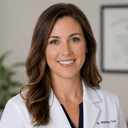
Dr. Medeline Yost
Chief Medical Officer, Augustun
Dr. Medeline Yost is an Internal Medicine physician and an emerging leader in clinical innovation. As Chief Medical Officer at Augustun, she helps shape AI-powered tools that streamline clinical documentation and support physicians in delivering higher-quality care. Her professional interests include medical education, workflow redesign, and the responsible use of AI in healthcare — building systems that let clinicians spend more time with patients and less on administrative tasks.